

 Español
  Français
  Deutsch
  Italiano
  Português
  Українська
  Русский
  Türkçe
  Polski
  Nederlands
  Čeština
  Svenska
  עברית
עברית  العربية
  فارسی
فارسی  简体中文
简体中文  日本語
日本語  한국어
한국어  हिन्दी
  Melayu
  Indonesia
  Tiếng Việt
 Ultrasonic Generator Technical Overview

Ultrasonic generators are the core component of ultrasonic cleaning systems, responsible for converting electrical energy into the high-frequency electrical signals that drive the transducers. These transducers then convert the electrical signals into mechanical vibrations, creating the cavitation effect in the cleaning solution that removes contaminants. The performance and reliability of the ultrasonic generator are crucial for effective and efficient cleaning. This article will explore the technical aspects of ultrasonic generators, particularly those offered by Beijing Ultrasonic, including their features, specifications, and adjustment procedures.
1. Ultrasonic Generator Features and Functions
Beijing Ultrasonic’s generators are designed with advanced microcomputer control technology, offering a range of features and functions that enhance their performance and reliability. A key feature is automatic frequency tracking, enabled by digital frequency synthesis. This ensures that the generator always operates at the most suitable frequency for the connected transducer, optimizing the cleaning process. This feature eliminates the need for manual frequency tuning and ensures consistent cleaning results.
Furthermore, the generators are equipped with comprehensive protection mechanisms against overheating and excess current. These safeguards are critical for preventing damage to the generator and the ultrasonic cleaning system, even during extended operation. The digital adjustment of ultrasonic power allows for flexibility and efficiency in cleaning different types of objects and contaminants. The output power can be precisely controlled from 0% to 100%, ensuring optimal cleaning without causing damage to sensitive parts.
An accurate timer is also integrated into the generator, which allows for precise control of the cleaning cycle and prevents both under-cleaning and over-cleaning. The risk of cavitation erosion, which can occur with prolonged exposure to ultrasound, is mitigated by the timer function. Moreover, the generator includes an external control connector, which enables the integration with other control devices. Lastly, the unit features a frequency display, allowing operators to monitor the operating frequency in real-time.
2. Ultrasonic Generator Technical Parameters
Beijing Ultrasonic generators are designed with specific parameters to ensure efficient and reliable performance. The working voltage for these units is 220V ±10%, making them compatible with standard power supplies. The working frequency is available in different ranges, including 28 kHz, 40 kHz, 80 kHz, and 135 kHz, each with a tolerance of ±5%.
The working current varies depending on the generator’s power output. Below is a table showing the relationship between power output and working current:
| Power (W) | Working Current (A) |
|---|---|
| 300 | 1.2 |
| 600 | 2.5 |
| 900 | 3.5 |
| 1200 | 4.5 |
| 1500 | 5-5.5 |
| 1800 | 6-6.5 |
| 2000 | 6.5-7 |
| 2400 | 7.5-8 |
It’s important to note that the device should not be operated continuously at its maximum working current to ensure its longevity and reliability. The power control range is from 0 to 100%, providing flexibility in cleaning different types of materials. The time control can be set from 0 to 59 minutes and 59 seconds, while the ambient temperature range for operation is 0 to 40 °C, with a relative humidity range of 40%-90%. The generator includes internal case overheat protection, which triggers at 65 °C.
The physical dimensions of the ultrasonic generator also vary based on its power rating. For generators with a power rating of less than 1200W, the dimensions are 300mm x 360mm x 160mm (L x W x H). For those with 1500W or greater, the dimensions are 500mm x 360mm x 160mm.
3. Ultrasonic Generator Options from Beijing Ultrasonic
Beijing Ultrasonic offers a comprehensive range of ultrasonic generators to meet various cleaning requirements. These include generators with power outputs ranging from 300W to 2400W, with frequencies below 45kHz and above 50 kHz. There is also a three-frequency digital ultrasonic generator available, which allows for increased flexibility in cleaning.
-
![[100-120V] Ultrasonic Transducer Driver Circuit & Transducer Bundles](https://www.bjultrasonic.com/wp-content/uploads/2014/03/100-120V-Ultrasonic-Transducer-Driver-Circuit-Transducer-Bundles-Above-60W-600x600.jpg)
[100-120V] Ultrasonic Transducer Driver Circuit & Transducer Bundles (13)
-
![[100-120V/200-240V] Ultrasonic Transducer Driver Circuit & Transducer Bundles](https://www.bjultrasonic.com/wp-content/uploads/2013/07/Digital-Ultrasonic-Transducer-Driver-Circuit-Transducer-Bundles-1-600x600.jpg)
[100-120V/200-240V] Ultrasonic Transducer Driver Circuit & Transducer Bundles (7)
-
![[200-240V] Ultrasonic Transducer Driver Circuit & Transducer Bundles](https://www.bjultrasonic.com/wp-content/uploads/2014/05/200V-240V-Ultrasonic-Transducer-Ultrasonic-Generator-2-600x600.jpg)
[200-240V] Ultrasonic Transducer Driver Circuit & Transducer Bundles (13)
-
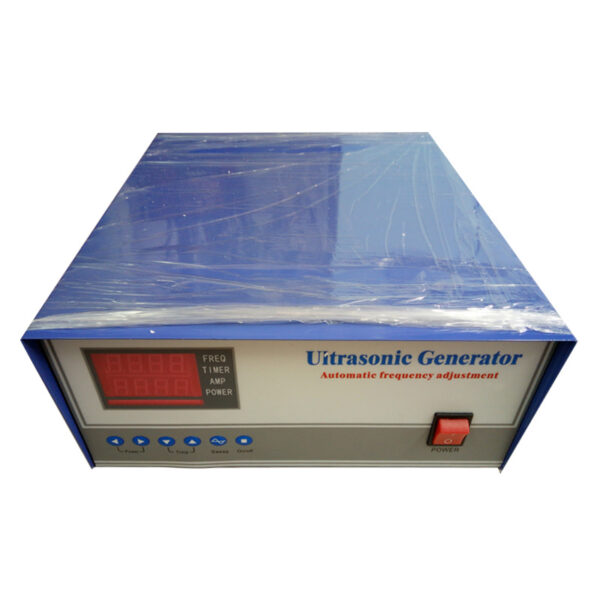
Digital Ultrasonic Generator (14)
-

Digital Ultrasonic Transducer Driver Circuit & Transducer Bundles (7)
-

Ultrasonic Transducer Driver Circuit (23)
4. Ultrasonic Generator Front Panel

The front panel of the Beijing Ultrasonic generator is designed for user-friendly operation and monitoring. It includes a display window, which shows values for power, time, working conditions, and any error messages. The power buttons enable the adjustment of power output, with one button to increase power and another to decrease it. Similarly, the time buttons allow the user to adjust the working time, with buttons to increase and decrease.
A sweep button is also present on the panel which allows users to choose between normal and sweep frequency modes, enabling different cleaning patterns. The on/off button allows the user to pause and resume the operation of the generator.
5. Frequency Adjustment
Frequency adjustment is essential to match the generator’s output to the transducer’s resonant frequency. To adjust the frequency of the Beijing Ultrasonic generator, the case must be opened to access the internal components. Locate the blue button, which allows adjustment of the current the transducer can handle. For example, a 28kHz transducer has a frequency range of 27kHz to 31kHz, while a 40kHz transducer has a frequency range of 38kHz to 42kHz.

6. Current Adjustment
Current adjustment is crucial for ensuring optimal performance and preventing damage to the generator. Beijing Ultrasonic generators utilize a computer-controlled system for debugging. Below are the steps for adjusting the current:
- Plug in the power supply.
- Connect an ammeter with a 10A capacity to the power supply’s lead-in terminal.
- Turn on the power and check the ammeter reading. For a 1200W generator, the reading should be less than 5A.
- Display the frequency on the generator’s window. This should be the normal working frequency.
- Find the maximum working current within the transducer’s specified frequency range.
- If the current and frequency are low, lessen the matching inductance by widening the air gap of the magnetic core. This is done by placing sheets of highland barley paper in the air gap.
- If the current and frequency are high, increase the matching inductance by shrinking the magnetic core’s air gap.
- Always turn off the power supply before adjusting the magnetic core’s air gap, and monitor the changes to the current.
- Adjust the current to be 4-4.5A and the frequency to be in the 27.8kHz-29kHz range.
- Readjust the frequency after every adjustment to ensure that the working current is always at the maximum point.

Reducing the matching inductance increases the harmonic frequency and current, while increasing the matching inductance decreases them. When adjusting, make sure the operating frequency is not too low and that the current does not exceed the rated current of the generator, as this can damage the power tube.
In conclusion, Beijing Ultrasonic’s ultrasonic generators are engineered with advanced technology to provide reliable and efficient performance for ultrasonic cleaning applications. The automatic frequency tracking, comprehensive protection mechanisms, adjustable power and timer functions, and the range of models available ensure that there is an ideal option for various cleaning needs. The detailed adjustment procedures provided for both frequency and current ensure the optimized operation of the ultrasonic generator.